
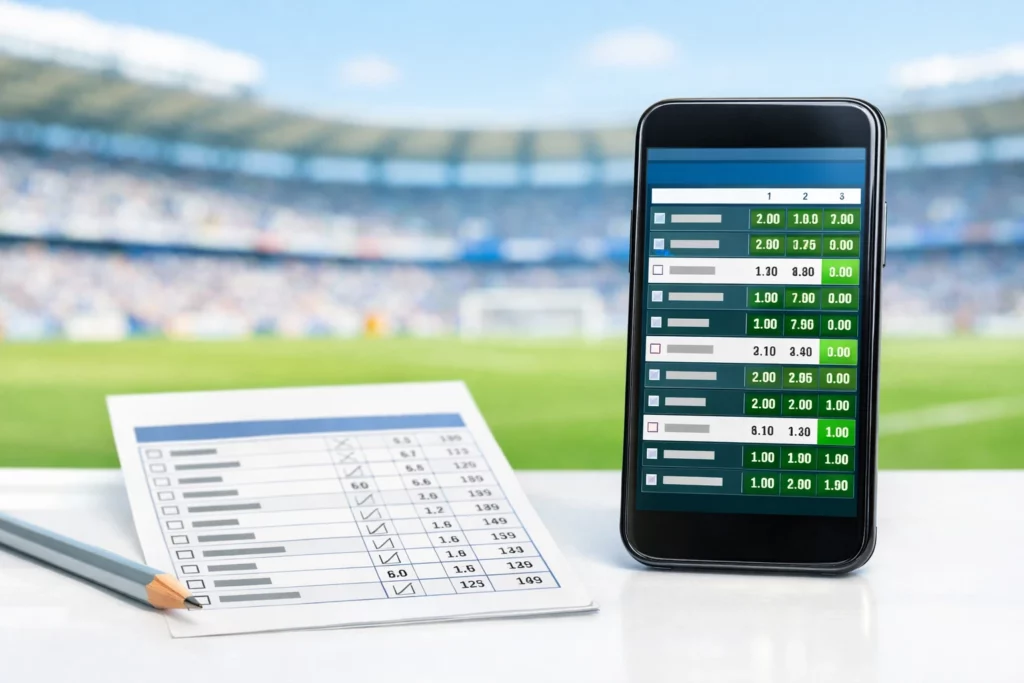

This beginner guide explains how to read betting odds. We use the decimal format, because it is the standard in Belgium. First, you will learn how decimal odds work. Then you will see how to calculate potential returns and derive implied probability. Next, we explain why the totals can exceed 100 percent. Finally, we show why comparing odds matters and how fractional and American formats relate to decimals.
How to read betting odds: what decimal odds are
Decimal odds show how much a winning bet returns for each unit staked. The number combines your original stake and the potential profit. For example, odds of 2.50 return 2.50 units for every unit staked. That total includes your stake plus the profit. Decimal odds are easy to read and to use in calculations. That is why Belgian bookmaker platforms display them.
Calculating potential returns
To find your return, multiply your stake by the decimal odds. This gives the total payout, including your original stake. For instance, a fictional stake of 10 units at odds of 2.50 returns 25 units. Subtract the stake, and the profit is 15 units. Use this quick check before you place a bet. However, remember that the example is illustrative. It is neither a recommendation nor an offer.
Converting odds into implied probability
You can turn decimal odds into an implied probability. The formula is simple: 1 divided by the decimal odds. The result is a number between 0 and 1, which is often shown as a percentage. For example, 1 divided by 2.50 equals 0.40. That means an implied probability of 40 percent. However, this figure does not guarantee a real-world chance. It simply shows how the operator prices each outcome.
The bookmaker margin inside odds
Add up the implied probabilities of all outcomes in a market. The total usually exceeds 100 percent. This happens because bookmakers build a margin into their odds. The margin covers operating costs and profit. It is sometimes called the overround. As a result, odds are not a pure reflection of likelihood. Therefore, comparing prices across operators can help you find better value.
Why compare odds
Licensed bookmakers in Belgium can price the same outcome differently. Even small gaps change your potential return. So, a comparison of odds between licensed bookmakers remains useful. You may also want to follow live betting markets. In addition, you can evaluate cash out options or a bet builder feature. Above all, keep responsible gambling in mind. A neutral odds comparison tool helps you spot the best decimal odds for your selections.
Fractional and American formats
Two other formats exist, and they are useful to recognise. Fractional odds appear as X/Y. They show the profit relative to the stake. For example, 3/2 means a profit of 3 units for every 2 units staked. American odds use a plus or minus sign with a number. A positive number shows the win on a 100-unit stake. A negative number shows the stake needed to win 100 units. Both convert to decimal odds with a simple calculation. In Belgium, decimal odds are standard. Still, knowing the equivalents helps you read international coverage.
Responsible gambling reminder
Betting should remain entertainment. Only people aged 21 or over may bet in Belgium. If gambling starts to feel like a problem, look into EPIS self-exclusion. In addition, support services are available in Belgium.
Frequently asked questions
What do odds of 2.00 mean?
Odds of 2.00 mean that a winning bet returns twice the stake in total. For example, a 10-unit stake would yield 20 units. That total includes your 10-unit stake and 10 units of profit.
How do I calculate my return from odds?
Multiply your stake by the decimal odds to get the total payout. For example, 15 units at odds of 1.80 returns 15 times 1.80, which is 27 units. This payout includes your original stake.
What is implied probability?
Implied probability is the chance suggested by the odds. You calculate it as 1 divided by the odds. For example, odds of 2.50 give 1 divided by 2.50, or 40 percent. Therefore, it is a way to read the price.
Why do odds differ between bookmakers?
Bookmakers set odds based on their own risk assessments, market flow and margins. As a result, prices vary across operators. They also reflect how a bookmaker balances its book. Therefore, comparing odds across licensed bookmakers in Belgium helps you find the best available price.

+21 Gambling can be addictive. Stop in time! More information at stopoptijd.be.